28 Sept 2025
Making Your Dental Practice AI-Ready: A Data-Driven Approach
Transform your dental practice with AI. Learn how to prepare your data for AI success and gain a competitive edge in the dental industry.

Mounir Atassi
Co-Founder
The £12.9 Million Question
In 2025, whilst 35% of dentists have implemented AI in their practices (1), the stark reality is that 30% of generative AI projects will be abandoned after proof of concept due to poor data quality, inadequate risk controls, escalating costs or unclear business value (2). For dental practices and DSOs, this represents a critical inflection point.
The difference between AI success and failure? Data readiness.
Just as OneData's whitepaper states, "AI is only as powerful as the data on which it is built." For dental practices, this means transforming scattered patient records, imaging data, and operational metrics into structured, governed data products that fuel AI innovation.
The Current State: Where Dental AI Stands in 2025
The dental AI market tells a compelling story. The AI in dentistry market is valued at USD 421.0 Mn in 2024 and is predicted to reach USD 3,117.6 Mn by the year 2034 at a 22.3% CAGR (3). Meanwhile, 108 AI-powered dental products have received FDA approval (4), signalling regulatory confidence in the technology.
Yet, for many dental practices, the journey to AI adoption remains fraught with challenges:
The Data Dilemma
Fragmented Systems: Patient data scattered across practice management software, imaging systems, and paper records
Quality Issues: Inconsistent data entry, duplicate records, and incomplete patient histories
Compliance Concerns: New requirements from the U.S. Department of Health and Human Services regarding HIPAA compliance will push organizations to strengthen their data protection and reporting practices (5)
The Integration Challenge
DSOs face particular hurdles. DSOs often struggle with integrating new acquisitions or practice locations into their existing IT infrastructure. This can lead to compatibility issues between different practice management software systems, inconsistent patient experiences, and increased costs from redundant IT setups (6).
Understanding Data Products: Your Blueprint for AI Success
Drawing from enterprise best practices, a data product approach transforms how dental practices manage their information assets. Rather than treating data as a byproduct of operations, data products position it as a strategic asset.
What Makes a Dental Data Product?
Structured & Standardised: Patient records, treatment histories, and imaging data organised in consistent formats
Governed & Secure: Clear ownership, access controls, and audit trails meeting HIPAA requirements
Discoverable & Reusable: Centralised catalogues allowing AI systems to easily access relevant data
Optimised for AI: Enriched with metadata, properly labelled for machine learning applications
The Four Pillars of AI-Ready Dental Data
1. Clinical Data Excellence
Transform your clinical data into AI-ready assets:
Standardised Treatment Codes: Ensure consistent coding across all providers
Complete Medical Histories: Integrate medical and dental records for holistic patient profiles
Imaging Metadata: Properly tag and categorise radiographs, CBCT scans, and intraoral images
Real-World Impact: AI-backed providers have been shown better case acceptance and practice profitability (7), with practices reporting revenue growth of up to $80,000 annually through improved patient acceptance rates and early detection of dental issues (8).
2. Operational Data Integration
Your practice management data holds untapped potential:
Appointment Analytics: Historical patterns for predictive scheduling
Revenue Cycle Data: Insurance and NHS claim patterns for automated processing
Inventory Management: Usage patterns for predictive ordering
DSO Advantage: 60% of practices saw same-store production growth in 2024, despite economic challenges (9), largely through better data utilisation.
3. Patient Experience Data
Modern dental AI thrives on comprehensive patient insights:
Communication Preferences: Channel preferences for automated reminders
Treatment Acceptance Patterns: Historical responses to treatment recommendations
Satisfaction Metrics: Post-visit surveys and review data
The Payoff: 59% of patients are more likely to trust their dentist if AI is utilised in their care (10).
4. Compliance and Security Framework
Build trust through robust data governance:
Access Controls: Role-based permissions for sensitive data
Audit Trails: Complete records of data access and modifications
Encryption Standards: End-to-end protection for patient information
Regular Assessments: Continuous monitoring for vulnerabilities
Your Roadmap to AI Readiness: A Practical Guide
Phase 1: Assess Your Current State (Weeks 1-2)
Data Inventory Audit:
Map all data sources across your practice
Identify data quality issues and gaps
Assess current security measures
Key Questions:
Where does patient data currently reside?
What percentage of records are digitised?
How consistent is data entry across providers?
Phase 2: Build Your Data Foundation (Weeks 3-8)
Priority Actions:
Standardise Data Entry: Implement templates and protocols
Clean Historical Data: Address duplicates and incomplete records
Establish Governance: Assign data owners and create access policies
Quick Win: Start with imaging data - it's typically the most structured and offers immediate AI benefits for diagnosis.
Phase 3: Create Your First Data Products (Weeks 9-12)
Recommended Starting Points:
Diagnostic Imaging Product: Organised radiographs with proper metadata
Patient Risk Profile Product: Combined medical/dental histories for predictive analytics
Operational Planning Product: Historical appointment data for case acceptance prediction and chair utilisation optimisation
Phase 4: Deploy AI Solutions (Months 4-6)
High-Impact Applications:
Automated Diagnosis Support: AI-powered tools assist dentists in identifying dental decay up to five years earlier than traditional methods
Treatment Planning AI: Personalised recommendations based on patient history
Revenue Cycle Automation: Predictive claim processing and denial management
Overcoming Common Barriers
Technical Concerns
Technical concerns (average score: 3.82 ± 0.68) were the main barriers to AI adoption (11).
Solution: Partner with dental-specific AI providers who understand your workflows. Look for solutions offering:
Seamless integration with existing practice management systems
Comprehensive training programmes
Ongoing technical support
Financial Considerations
Initial investment concerns often delay adoption.
ROI Reality Check:
Average practice manager spends 15 hours on manual reporting, losing £47,000+ annually (12)
AI appointment systems can recover 60-70% of unuesed chair time
Diagnostic AI improves case acceptance by 20-30%
Change Management
Staff resistance can derail AI initiatives.
Success Strategy:
Start small with one department or use case
Celebrate early wins publicly
Provide comprehensive training and support
Position AI as an assistant, not a replacement
The Competitive Advantage: Why Act Now
The dental industry stands at a crossroads. From 2023 to 2024, the percentage of respondents who reported that they have integrated some AI modules into their workflows increased significantly from 9% to 18% (13). Those who build AI-ready data foundations today will:
Enhance Diagnostic Accuracy: Catch issues earlier, improve patient outcomes
Optimise Operations: Reduce administrative burden by 25-30%
Increase Revenue: Improve case acceptance and reduce missed opportunities
Future-Proof Their Practice: Stay ahead of regulatory changes and patient expectations
Conclusion: Your Data, Your Future
As the OneData whitepaper emphasises, "The companies that embrace data products today will dominate the AI-driven economy of tomorrow." For dental practices, this means the difference between leading innovation or playing catch-up.
The path forward is clear:
Treat your data as a strategic asset
Build structured, governed data products
Deploy AI solutions that enhance both clinical and operational excellence
Continuously refine and expand your AI capabilities
The question isn't whether to become AI-ready, but how quickly you can transform your data into the foundation for tomorrow's intelligent dental practice.
How ClinBI Can Help
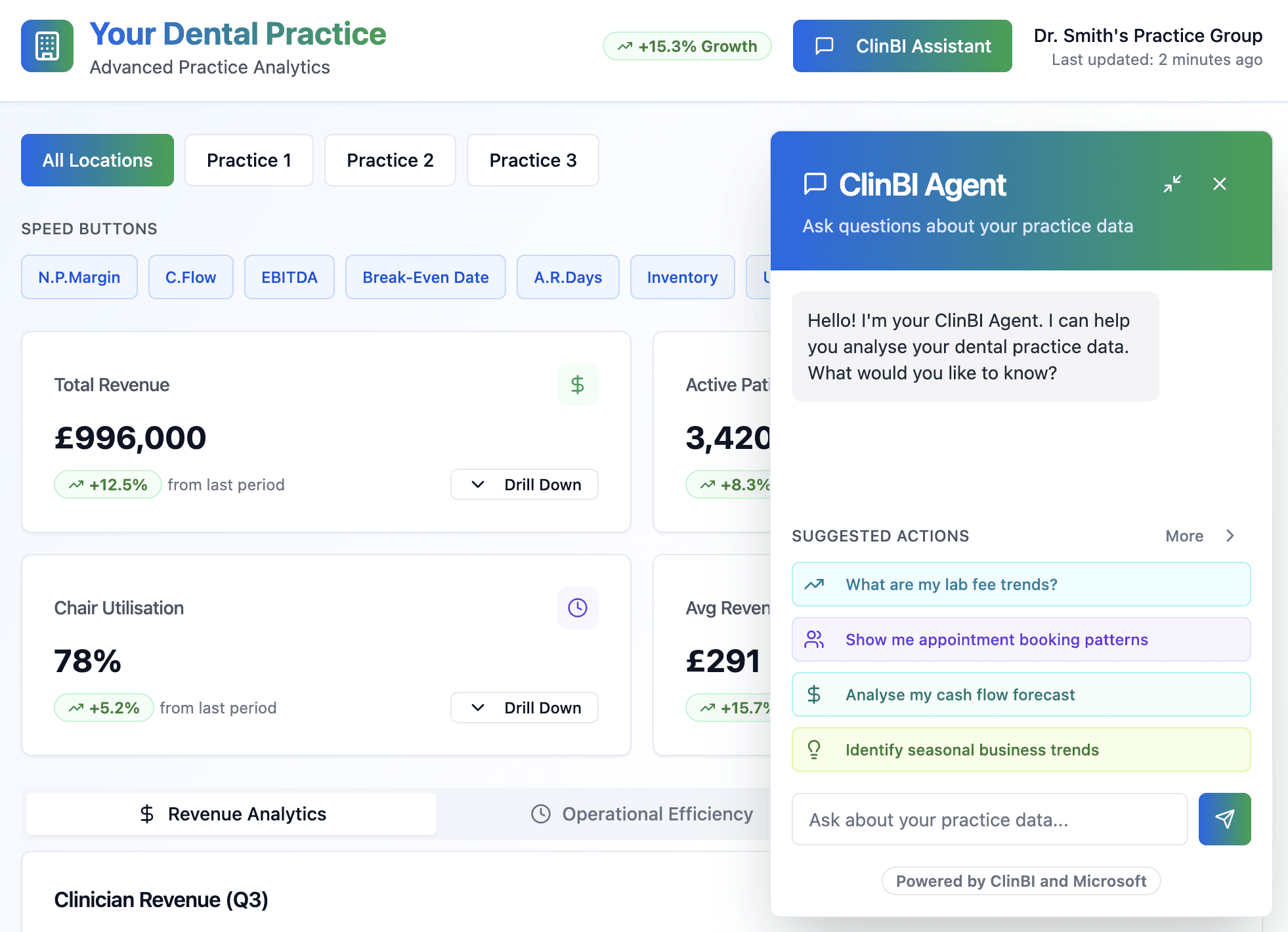
At ClinBI, we've guided 50+ dental practices and DSOs through successful AI transformations using our proven Data Products Framework. We combine deep dental industry expertise with cutting-edge data science to deliver measurable results within 90 days.
Whether you're a single practice or multi-location DSO, we'll assess your current data maturity, identify quick wins, and create a tailored roadmap to AI success - without disrupting your operations.
Ready to join the AI revolution?
Book a free 30-minute consultation and discover:
Your AI readiness score
Immediate opportunities for improvement
ROI projections for your practice
Don't let competitors gain the AI advantage. Transform your data into your greatest asset.