17 Mar 2026
Why Your Dashboards Aren't Improving Your Profitability
Discover why your clinic group dashboards aren't boosting profitability and learn how continuous performance intelligence can transform your decision-making process.

Mounir Atassi
Co-Founder

Your clinic group has dashboards. Your practice management system generates reports. Your accounting software tracks revenue and expenses. You might even have a dedicated analyst pulling numbers into spreadsheets every month.
So why does it still take your team weeks to answer a straightforward question like: "Which of our locations is actually the most profitable — and why?"
If that question sounds familiar, you're not alone. Across the clinic groups we work with, dental, veterinary, optometry, physiotherapy, the pattern is remarkably consistent. They have more data than ever, more reporting tools than ever, and yet the fundamental decisions that drive profitability are still being made on gut feeling, incomplete information, or spreadsheets that are already out of date.
The problem isn't a lack of data. It's a lack of the right kind of analysis.
Dashboards Tell You What Happened. That's All.
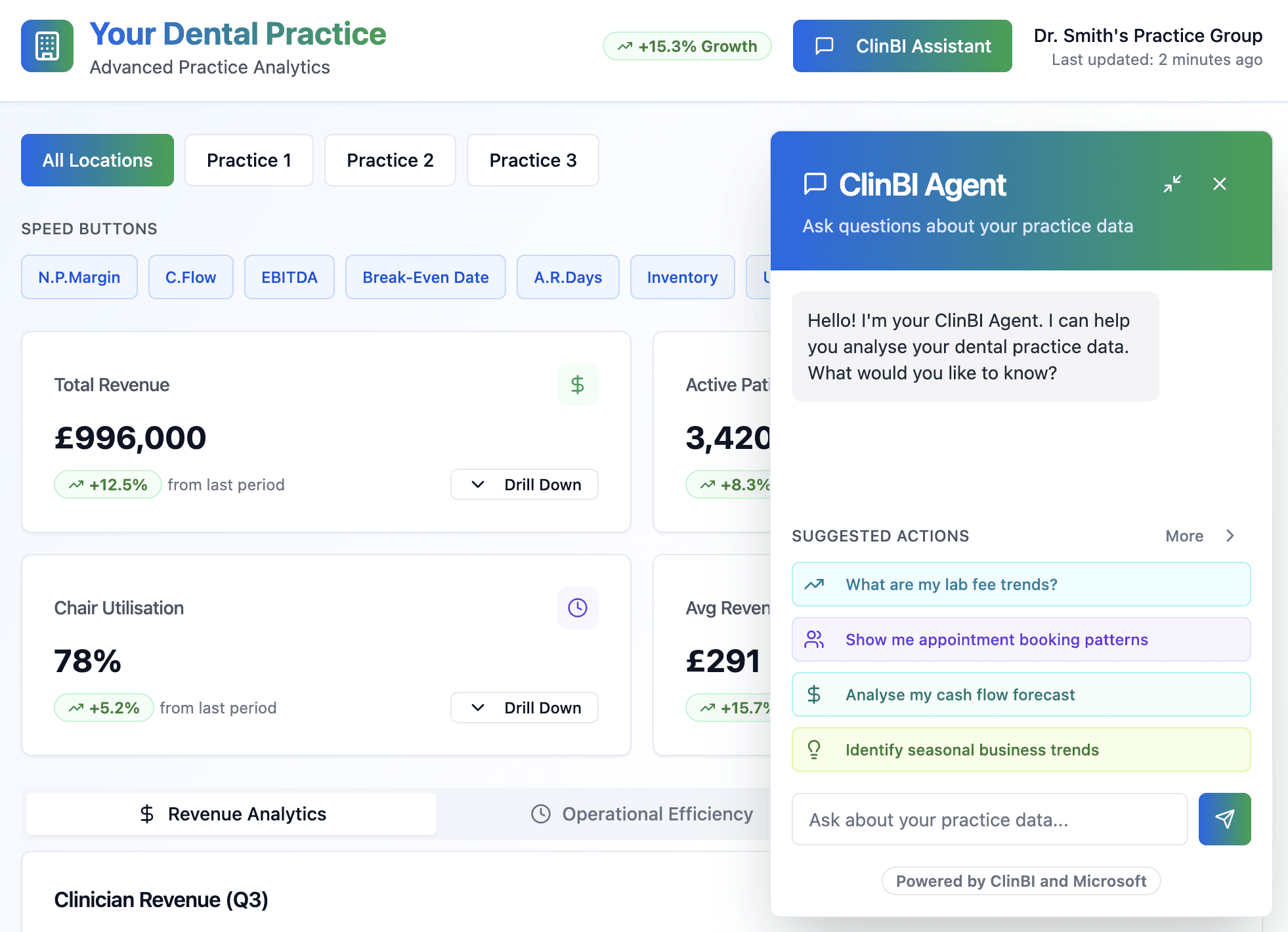
Let's give dashboards their due. A well-built dashboard can show you last month's revenue by location, your appointment volumes, your cancellation rates, and your top-line financial trends. This is what analysts call descriptive analytics; it describes what happened.
And it's genuinely useful. You need to know what happened. The problem is that most clinic groups stop here and assume the job is done.
Consider this scenario: Location A generated £320,000 last month. Location B generated £280,000. The dashboard says Location A is your top performer. Case closed?
Not even close. What if Location A's costs are £40,000 higher? What if Location B has 30% more unused capacity that could be filled with minimal additional cost? What if Location A's marketing is generating high volumes of leads that never convert to profitable treatments, while Location B's smaller patient base is far more valuable per head?
Your dashboard can't tell you any of this, because it wasn't designed to. Dashboards show you the surface. The performance story that actually drives profitability lives underneath.
This isn't just a theoretical gap. A systematic review of healthcare analytics literature found that nearly half of all healthcare analytics applications are purely descriptive, focused on reporting what happened rather than understanding why it happened or what to do about it. The organisations stuck at this level are, by definition, making decisions with an incomplete picture.
The Three Levels of Analytical Maturity
In our experience working with multi-site clinic groups, analytical capability falls into three distinct levels. Understanding where your organisation sits is the first step towards moving forward.
Level 1: Descriptive, "What happened?"
This is where dashboards and standard reports live. Revenue by month, appointments by clinician, expenses by category. Most clinic groups are here. The data is accurate, but it's static and backward-looking. It tells you the score but not how to change the game.
Level 2: Diagnostic, "Why did it happen?"
This requires connecting data across systems — your practice management software, your accounting platform, your marketing tools, your HR data — and analysing it holistically. Why did treatment acceptance drop at one location but not another? Why is one clinician's chair utilisation 20% higher than a colleague in the same practice? Why did your marketing spend double last quarter without a corresponding increase in profitable patients?
Most clinic groups never reach this level. Not because the questions aren't important, they clearly are, but because answering them requires specialist analytical capability that their existing tools and teams aren't designed to provide. The data exists across multiple disconnected systems, and no single dashboard can bridge that gap.
Level 3: Prescriptive, "What should we do about it?"
This is where analysis translates into action. Not just identifying that a performance gap exists, but quantifying it in pounds and percentages, attributing it to specific causes, and surfacing specific operational changes that would close it. Research into healthcare analytics maturity shows that organisations operating at this level achieve dramatically higher returns , multiples of what Level 1 organisations achieve, precisely because they're acting on insights, not just observing metrics.
This is the level where profitability actually improves. And it's the level that dashboards, structurally, cannot reach.
Five Things Dashboards Structurally Cannot Do
There are specific, high-value analytical capabilities that no dashboard, however well designed, can deliver. These are the capabilities that separate clinic groups that think they're performing well from those that know exactly where their money is being made and lost.
1. Per-procedure profitability
Understanding the true cost of delivering each type of treatment — not just the revenue it generates, but the clinician time, materials, lab costs, and share of overheads it actually consumes. Many clinic groups discover that some of their most popular procedures are actually loss-makers once fully costed. Without this analysis, you're flying blind on pricing and treatment mix decisions.
2. Clinician-level cost attribution
Knowing not just what each clinician bills, but what each clinician actually costs the business when you account for their time allocation, the procedures they perform, their treatment acceptance rates, and their proportional share of overheads. This is the insight that transforms performance conversations from subjective opinion into objective, data-driven dialogue.
3. Genuine cross-location comparison
True like-for-like comparison across sites requires normalising for size, case mix, clinician mix, local demographics, and cost structures. A simple revenue-per-location chart, the kind your dashboard probably shows, is misleading at best. Two locations generating identical revenue can have wildly different profitability profiles, and only deeper analysis can reveal why.
4. Marketing attribution to patient lifetime value
Not just "how many leads did this campaign generate?" but "what is the lifetime value of the patients that came through this channel, and what did it cost to acquire them?" Most clinic groups can't answer this because the marketing data, the appointment data, and the financial data live in three different systems that have never been connected.
5. Hidden capacity identification
Understanding exactly how much unused capacity exists at each location, when it occurs, and what it's costing you in unrealised revenue. This goes beyond "empty chair time" in a scheduling report. It's about quantifying the gap between what your clinics could produce and what they actually do produce, and putting a pound figure on that gap.
None of these capabilities come from adding another dashboard or upgrading your existing one. They require a fundamentally different approach — one that connects data across all your systems and applies specialist methodology to turn that data into actionable intelligence.
Are You Measuring, or Are You Improving?
There's a crucial distinction that gets lost in the noise of the analytics market. Measuring performance and improving performance are not the same activity. You can measure perfectly and never improve, because measurement without diagnosis and prescription is just observation.
The multi-site healthcare sector is consolidating rapidly. In dentistry alone, industry analysts predict consolidation could reach 75% within the next fifteen years, up from around 31% today. As competition intensifies and margins tighten, the clinic groups that achieve meaningful, sustained profitability improvement will be those that move beyond measurement into continuous performance analysis.
They won't just ask "what happened last month?" They'll ask "where are the five biggest opportunities to improve performance right now, and what are they worth in pounds?"
That shift, from retrospective reporting to continuous, forward-looking performance intelligence, is what separates clinic groups that grow from those that plateau.
What Continuous Performance Intelligence Looks Like
Imagine having a permanent analytical capability embedded in your operations that:
Connects all your systems, practice management, accounting, marketing, HR, into a unified data environment, automatically
Continuously analyses performance across every location, every clinician, and every procedure category
Surfaces improvement opportunities in pounds and percentages, not just charts and graphs
Identifies hidden capacity, cost attribution patterns, and marketing efficiency gaps that your existing reports cannot see
Delivers all of this without requiring new headcount, system changes, or operational disruption to your clinics
This isn't a dashboard. It isn't a reporting tool you log into once a month. It's a fundamentally different capability, one that works continuously in the background, analysing your operational data and identifying where performance can improve.
And critically, it delivers this at a fraction of the cost of traditional consulting. A comparable engagement from a major consulting firm, with teams of analysts deployed across your locations for months, typically costs £700,000 to well over £1 million. When they leave, the analysis stops, and the insights begin to decay. Continuous performance intelligence stays embedded in your operations permanently.
Is Your Clinic Group Ready to Move Beyond Dashboards?
If your team is spending weeks consolidating data across locations, if your performance conversations rely on incomplete information, if you suspect there are profitability improvements hiding in your operations that you can't yet quantify, those are signals that your current analytical capability has reached its ceiling.
Dashboards got you this far. They won't take you further.
At ClinBI, we help multi-site clinic groups, dental, veterinary, optometry, physiotherapy, and beyond, move from descriptive reporting to continuous performance intelligence. If you're curious about what that shift could look like for your organisation, book a consultation and let's find your hidden performance improvements together.